The short answer
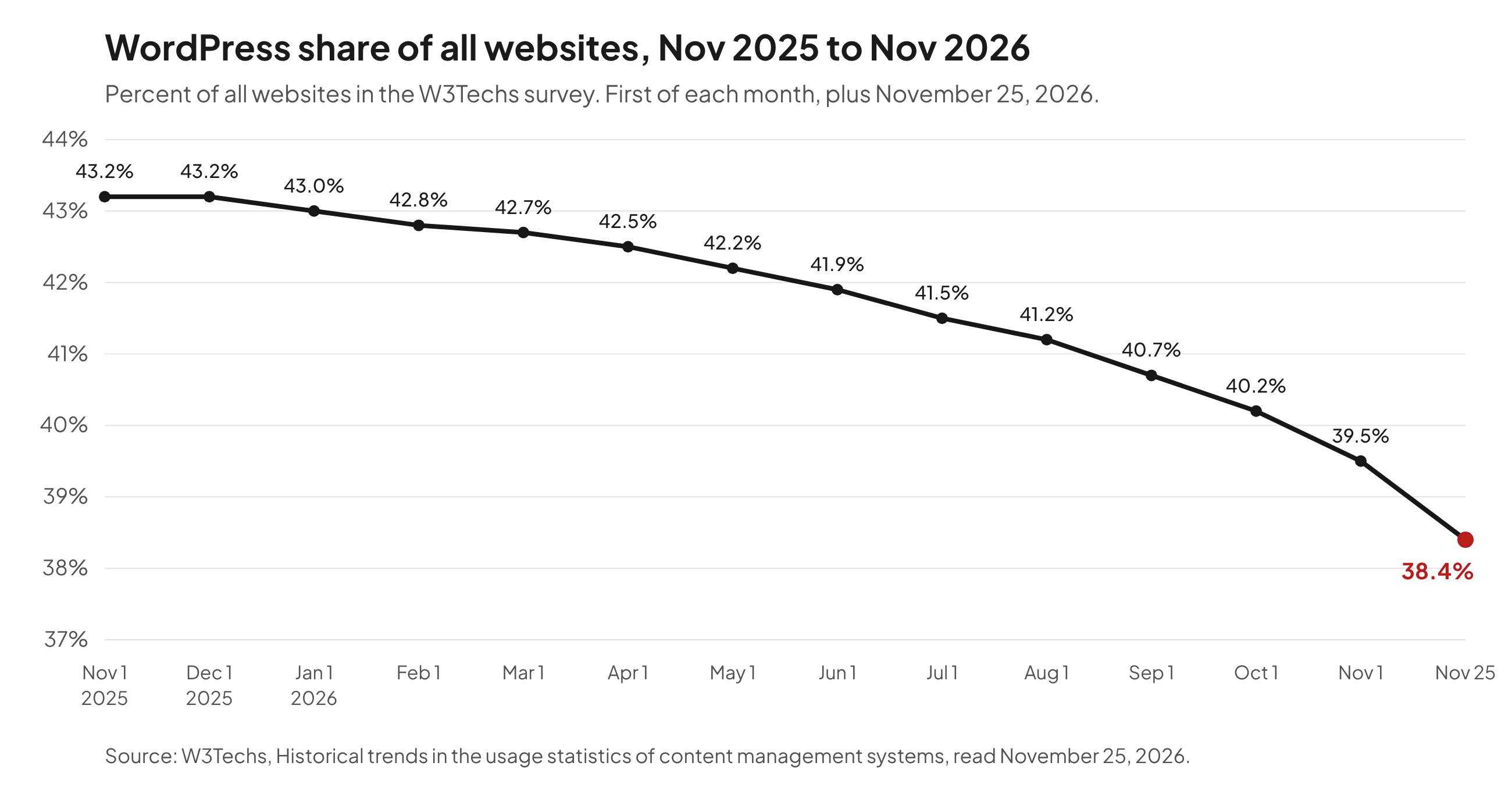
According to W3Techs, WordPress runs 38.4% of all websites as of November 25, 2026, and 57.3% of sites whose content management system W3Techs can identify. A year earlier, on November 1, 2025, it was 43.2% of all websites. The share has fallen every month in 2026, and faster since August. Most of the lost share shows up as sites with no CMS that W3Techs can detect, a group that grew from 28.6% to 33.0%, rather than as gains for Wix or Squarespace. WordPress is still the largest platform by a wide margin. If your site runs on it, the practical message is unchanged: keep it maintained and secure, and decide about moving based on your own site, not on the trend line.
What the numbers say
W3Techs surveys what it calls the relevant web, “well over 20 million sites,” and updates its reports daily. It reports two figures for each platform: its share of all websites, and its share of the sites where it can identify a CMS. On November 25, 2026, the content management overview showed WordPress at 38.4% of all websites and 57.3% of sites with a known CMS.
In the monthly trend table, WordPress went from 43.2% on November 1, 2025 to 39.5% on November 1, 2026, and to 38.4% on November 25. That is 4.8 percentage points since last November. The monthly drops were 0.1 to 0.4 points through August 1, then 0.5, 0.5 and 0.7 points in the next three months, and 1.1 points in the first 24 days of November.
For longer context, the W3Techs yearly table shows WordPress at its highest January reading on January 1, 2025, at 43.6% of all websites, and at 43.0% on January 1, 2026. Measured as a share of sites with a known CMS, the yearly market share table peaked at 65.2% on January 1, 2022 and now reads 57.3%.
Where the share went
Share of all websites in W3Techs’ monthly table (November 1, 2025) and overview (November 25, 2026):
| Platform | Nov 1, 2025 | Nov 25, 2026 |
|---|---|---|
| No detectable CMS (“None”) | 28.6% | 33.0% |
| WordPress | 43.2% | 38.4% |
| Shopify | 4.9% | 5.5% |
| Wix | 4.1% | 4.2% |
| Squarespace | 2.4% | 2.4% |
| Webflow | 0.9% | 0.8% |
| Lovable | not listed | 0.6% |
The biggest change is the “None” row, sites that use none of the systems W3Techs monitors. It grew 4.4 points, almost as much as WordPress lost. Shopify gained 0.6 points. Wix, Squarespace and Webflow barely moved. Lovable, an AI app and website builder, appears in the table for the first time at 0.6%. Astro, a framework popular for custom-built sites, is at 0.3%, and v0, another AI builder, at 0.1%.
So the trend does not look like owners moving from WordPress to the familiar hosted builders. It looks more like growth in custom-coded and AI-built sites, plus a smaller move to Shopify for online stores.
What the numbers do not tell you
- “None” is not a platform. It covers hand-coded sites, custom frameworks and anything W3Techs cannot fingerprint. A “headless” WordPress site, where WordPress manages the content but a separate front end serves the pages, may not show WordPress signs to a scanner and could be counted as None. We found no explanation from W3Techs for the size of this year’s jump.
- It counts websites, not traffic or businesses. W3Techs counts each site once, and treats subdomains as part of the main site, so it does not say how many businesses use each platform.
- Other trackers measure differently. BuiltWith, which looks at the top 1 million sites, found WordPress on 310,672 of them, about 31%, in data last updated November 5, 2026, as compiled by StatisticsGlobal. That is a different sample and method, so the two numbers should not be compared directly.
None of this changes the size gap. At 38.4% against Shopify’s 5.5%, WordPress still runs about seven times as many sites as the next platform in W3Techs’ survey (our calculation from the figures above).
If your site runs on WordPress
A falling share does not make a WordPress site less safe or less useful this week. Plugins, themes, hosts and developers are still widely available, and W3Techs reports that 71.0% of WordPress sites it sees run version 7. What a smaller share does not change is the work every WordPress site needs:
- Keep WordPress core, plugins and themes updated, with backups you have tested.
- Remove plugins you no longer use, and replace plugins that are closed or no longer maintained.
- Watch security advisories for the plugins you actually run.
- Know who to call if the site breaks or gets hacked.
Our free WordPress Health Check grades a site from the outside in about a minute. WordPress Maintenance covers ongoing updates, and WordPress Security covers hardening and monitoring.
Should you stay or move? A practical checklist
Market share is a poor reason to rebuild a site that works. These questions are better ones:
- Does the site do its job? If it brings in calls, leads or sales and you can update it, there is no urgent reason to move.
- What does it cost to keep running? Add up hosting, plugin licenses and the time or help it takes to keep it updated and fixed.
- Who edits it, and how often? If non-technical staff update pages weekly, WordPress’ editor and plugins are a real advantage. If the site rarely changes, a simpler setup may be enough.
- Which plugins does it depend on? List the features you cannot lose, such as forms, bookings, a store, memberships or courses, and check whether a new platform does each one.
- What would you lose in a move? Plan for page URLs and redirects, search rankings, form and analytics tracking, and email or CRM connections.
- Is the site in bad shape? If it is hacked, very slow, stuck on old PHP or built on abandoned plugins, the first decision is usually whether to repair it or rebuild, and that does not have to mean leaving WordPress.
If the site is broken or compromised, start with WordPress Rescue. If you are weighing a rebuild, see WordPress Modernization or WordPress Replacement.
AI-built sites have their own limits
AI builders can produce a good-looking site quickly, and their appearance in W3Techs’ data shows people are using them. Before you switch, check a few things:
- Who edits it later. Some AI-built sites are easy to change only by prompting the tool again, or by a developer working in code.
- Where it lives. Find out whether you can export the code and content and host it elsewhere, or whether the site stays on the builder’s platform.
- Security and updates still apply. A custom or AI-built site still has software components, forms and hosting that need updates. There is just no plugin dashboard reminding you.
- The basics. Confirm that forms, analytics, search settings, accessibility and page speed work before launch, not after.
The right platform is the one your team can run, update and pay for over the next few years. For many small businesses that is still WordPress, kept in good order.
FAQ
What share of websites use WordPress in November 2026?
According to W3Techs, WordPress runs 38.4% of all websites and 57.3% of sites with a known content management system, as of November 25, 2026.
How much has WordPress market share fallen?
W3Techs' monthly table shows WordPress at 43.2% of all websites on November 1, 2025 and 38.4% on November 25, 2026, a drop of 4.8 percentage points. Its highest January reading was 43.6% on January 1, 2025.
Where did WordPress lose share to?
Mostly to sites with no CMS W3Techs can detect, which grew from 28.6% to 33.0% of all websites over the same period. Shopify rose from 4.9% to 5.5%, and the AI builder Lovable appeared at 0.6%. Wix and Squarespace were nearly flat.
Is WordPress dying?
No. It still runs about seven times as many sites as Shopify, the next platform in W3Techs' survey. Its share is falling, but a working WordPress site that is kept updated is not at more risk because of the trend.
Should I move my business website off WordPress?
Only if your own site gives you a reason: high running costs, features you cannot get, editing that is too hard for your team, or a site in poor shape. Weigh those against what a move costs, including redirects, search rankings and tracking.
Are AI-built websites a good replacement for WordPress?
They can be for simple sites, but check who can edit the site later, whether you can export and host it elsewhere, and how security updates, forms and analytics will be handled.
Sources
- W3Techs, "Usage statistics and market share of WordPress" (figures dated November 25, 2026). https://w3techs.com/technologies/details/cm-wordpress
- W3Techs, "Usage statistics and market shares of content management systems" (figures dated November 25, 2026). https://w3techs.com/technologies/overview/content_management
- W3Techs, "Historical trends in the usage statistics of content management systems" (monthly, read November 25, 2026). https://w3techs.com/technologies/history_overview/content_management/all
- W3Techs, "Historical yearly trends in the usage statistics of content management systems" (read November 25, 2026). https://w3techs.com/technologies/history_overview/content_management/all/y
- W3Techs, "Market share yearly trends for content management systems" (read November 25, 2026). https://w3techs.com/technologies/history_overview/content_management/ms/y
- W3Techs, "Technologies Overview" methodology (read November 25, 2026). https://w3techs.com/technologies
- StatisticsGlobal, "CMS Market Share 2026" (updated November 9, 2026), citing BuiltWith Trends data last updated November 5, 2026. https://statisticsglobal.org/cms-market-share/