The short answer
Most small and mid-sized businesses are running on a general-purpose chatbot, and that chatbot is usually ChatGPT. Google Gemini is a clear second. Microsoft Copilot shows up most where a company already lives in Microsoft 365, and Canva's AI features appear for design work. Specialized AI tools for sales, accounting, or marketing are still uncommon. For most firms, the practical question is not which tool to buy next, but whether the tools they already have are used in a shared, managed way rather than in private accounts.
That conclusion comes from five 2026 surveys, each with a different sample. Read together the surveys point in the same direction, and in this article we will walk through what they found and what it will mean for managing people in 2027.
What the 2026 surveys measured, and why the numbers differ
The surveys agree on the ranking of tools but not on the exact percentages. One survey sampled only AI users, while others sampled all small-business owners, aspiring founders, or leaders at small retail and e-commerce companies. When you compare figures, compare the order of tools and the size of the gaps, not single numbers. These surveys define a small business mainly by employee count, not revenue: two looked at firms with 50 or fewer employees, and the retail and e-commerce survey included companies with up to 500 employees and under $50 million in revenue.
The five sources are a Network Solutions and Fractl survey of 187 U.S. small-business owners already using AI, a Bluehost and ListenLabs survey of 350 owners of firms with 1 to 50 employees, a LegalZoom survey of 1,000 respondents split between aspiring founders and current owners, a TechNet and Morning Consult poll of 1,008 small retail and e-commerce leaders at companies with 500 or fewer employees and under $50 million in revenue, and McKinsey's State of AI global survey of organizations of all sizes, which does not name individual chatbot brands. Averaging the surveys of current owners, about four in five use AI and about half use it daily. A survey that also included aspiring founders found lower regular use.
ChatGPT is the default almost everywhere
In every survey that names tools, ChatGPT is the most widely used, typically by about two-thirds to four-fifths of respondents. It is also the tool people call their main one. For most teams, ChatGPT is the first place someone goes when they need a draft, a summary, or a second opinion. On average across these surveys, about three-quarters of respondents use ChatGPT. In the Network Solutions survey, which asked which tool people use most, 51% named it.
The Network Solutions report adds a useful detail. ChatGPT was the top pick for all ten business tasks the survey asked about, yet it never won more than half of owners for any single task. Owners keep a default and add other tools where the default falls short. That same survey found 73% had used more than one AI tool in the past three months, and 27% had used four or more.
For a manager, the takeaway is simple. Whatever your official policy says, it is very likely that some of your people are already using ChatGPT for work. That makes it the first tool worth configuring well, and the first one worth writing clear guidance for.
Gemini is a strong second for Google Workspace businesses, and Copilot is strong for Microsoft 365 businesses
Google Gemini is the consistent runner-up, used by roughly 60% of respondents in the broad surveys. Microsoft Copilot sits in the 40% range in two of them. Claude, Perplexity, and Meta AI trail. Which second tool a company leans on often depends on whether it runs on Google Workspace or Microsoft 365.
The numbers:
- TechNet and Morning Consult: Google Gemini 62%, Microsoft Copilot 44%, Canva AI 28%, Anthropic Claude 11%.
- LegalZoom: Google Gemini 59%, Microsoft Copilot 43%, Perplexity 17%, Claude 16%.
- Network Solutions: Gemini 64%, with 24% naming it their go-to tool; Claude 29%, Canva AI 24%, Microsoft Copilot 22%, Meta AI 18%.
- Bluehost: Gemini, Claude, and Copilot land in the middle of the range, well behind ChatGPT.
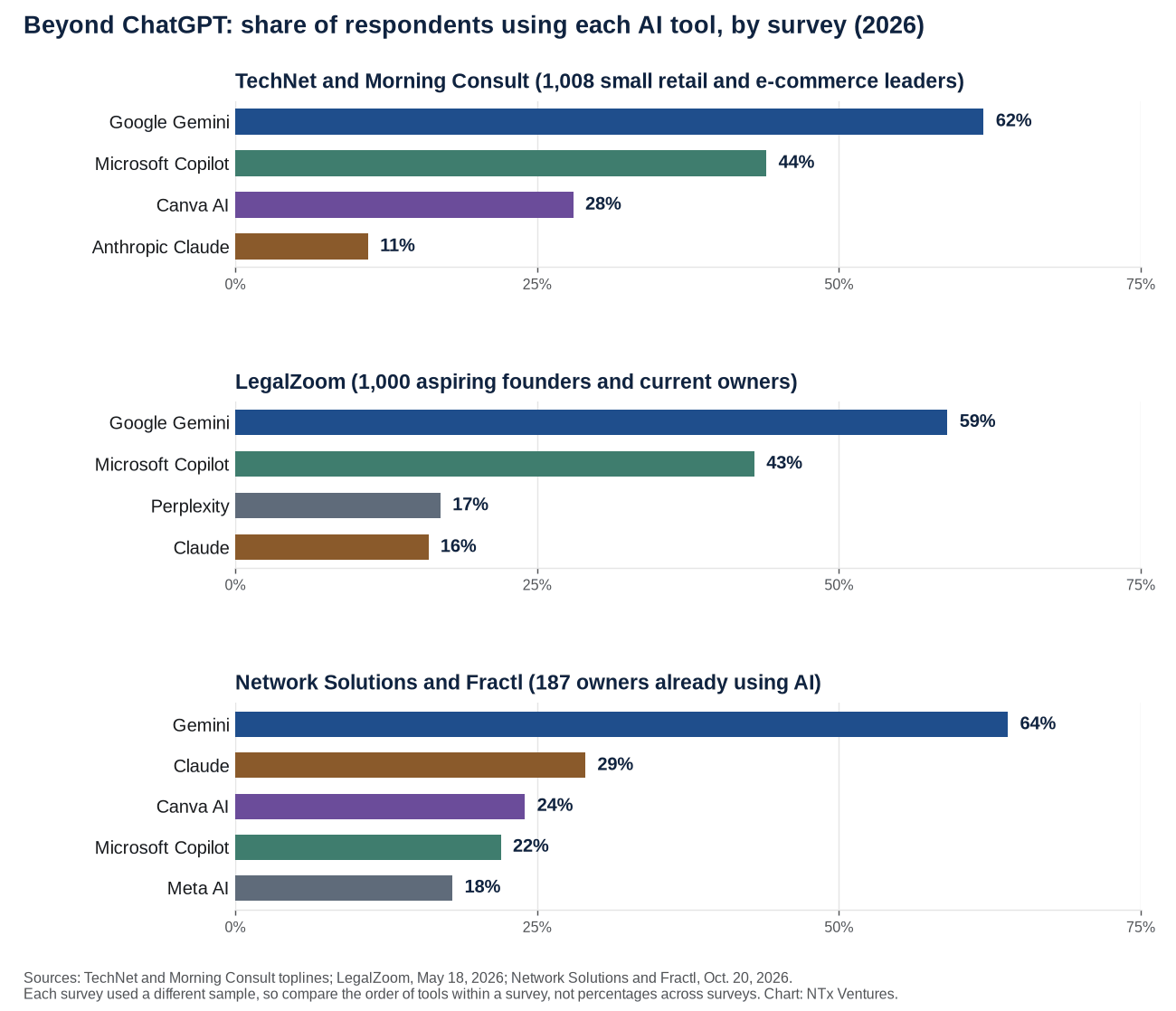
Copilot's lower share in the Network Solutions sample is worth noting. That sample is mostly solo owners, who may be less likely to run a managed Microsoft 365 plan; the survey does not say. In the TechNet poll, which reaches larger firms, Copilot is used by 44%. A reasonable reading is that Copilot adoption tracks the office suite a company has already paid for.
Specialty tools are still rare
Canva AI is the one design-oriented tool that appears with some regularity, at 24% to 28% where it was measured. For teams that produce their own social posts, slides, or marketing materials, it is often the second or third tool in use.
Tools built for a single function, such as sales, accounting, SEO, or website chat, show up in a small minority of businesses. Bluehost found each category in fewer than 12% of small businesses. TechNet's named tools tell the same story. Most of the AI in a typical company is still a general chat window.
In the TechNet and Morning Consult poll, the named specialized and embedded tools came in well below the general chatbots: Salesforce Einstein 15%, Grammarly IQ 9%, Shopify Magic 8%, HubSpot AI 8%, and Notion AI 6%. Bluehost reported that specialized tools for marketing, website chatbots, SEO, accounting, and sales each appear in fewer than 12% of the businesses it surveyed.
This does not mean specialized tools lack value. It means most firms have not yet connected AI to the systems where their work actually lives, such as the CRM, the accounting package, or the project tracker. That gap matters more for a company with 30 or 80 people than for a solo owner, because the cost of manual handoffs grows with every person and every system involved.
Before buying a specialized tool, it is fair to ask whether the team has agreed how to use the general one it already has.
Most AI use still happens by copy and paste
In most privately held businesses, a person copies information into a chatbot and then copies the answer back out. Bluehost describes the owner as the integration layer. That pattern is not limited to owners. Anyone with a browser can open a chat window, paste in a document or a question, and take the answer back into email, a spreadsheet, or a client file.
The downside is not only the extra steps. Each of those conversations lives in a separate account, with its own history and its own security settings. A manager often has no way to know how many of those accounts exist, what was pasted into them, or what each vendor will retain. One person may use a company workspace. Another may use a free personal account. A third may have turned on features that keep chat history. Those security postures are different, and they are usually invisible.
People do seem aware that answers need checking. Network Solutions found 67% of AI-using owners check AI's work rather than trusting it outright. LegalZoom found 30% always verify AI output used for business decisions and another 36% usually do. Checking the answer does not fix the larger problem: the work is still spread across an unknown number of siloed conversations.
Those silos have specific costs on a distributed team. One person pastes a client document into a personal account. Another gets a confident but wrong answer and forwards it. A third has written careful instructions that no one else knows about. None of this is visible from a manager's dashboard, and none of it is solved by adding another tool.
Among privately held businesses, larger firms use AI more often than very small ones, but most of them are still at the chatbot stage rather than connecting AI to the systems where work already lives.
What this means for businesses
LegalZoom's breakdown by size is the clearest signal. Regular AI use was 73% at businesses with 50 or more employees, 42% at businesses with 2 to 9 employees, and 39% among solo entrepreneurs. Higher reported use at larger firms could reflect company-wide policies that roll tools out to everyone, and it does not necessarily mean people are using the AI tools they have been given.
McKinsey's global survey shows the next step up. Chatbots are the most widely scaled AI tool, with 47% of respondents saying their organizations are scaling them enterprise-wide. But scale tracks size: 39% of organizations under $1 billion in revenue are scaling chatbots, compared with 64% at $1 billion or more.
Put together, a realistic picture of small and medium size businesses looks like this:
- A general chatbot, most often ChatGPT, used by many staff, some on company accounts and some on personal ones.
- Gemini or Copilot in use as well, depending on whether the company runs Google Workspace or Microsoft 365.
- Canva for design, if the team produces its own materials.
- Few or no AI tools connected to core systems.
- Little shared configuration, so each person's results depend on how they personally set things up.
Why a shared, centrally managed tool set matters more than the next tool
Because the default chatbot is what your team actually uses, the bigger risk is not picking the wrong brand. It is letting that use splinter across a hundred private accounts a manager cannot see. People sign up on their own, paste work into personal chats, and get results that never enter a shared system.
The more useful move is to pull everyday AI use onto a common, centrally managed set of tools. That usually means a company plan for ChatGPT, Gemini, or Copilot, tied to the business's existing Google Workspace or Microsoft 365 setup, so staff work in company accounts instead of personal ones. A shared ecosystem is what makes it possible to know who has access, what is retained, and which features are on.
Configuration comes after that. Instructions, shared workspaces, memory settings, and admin controls can shape whether the tool flatters people or challenges them, and whether sensitive information stays where it belongs. Those settings only reach the conversations the company can see. They cannot reach a private account no one has disclosed.
They also change. Both OpenAI and Google changed their reusable-assistant features in late 2026, so last year's setup may not still work.
Two practical guides in this series cover the details: how to set up configuration for ChatGPT, and how to set up configuration for Gemini. Each walks through the settings an individual manager controls, what an administrator controls, a suggested instruction for getting candid feedback instead of agreement, and what to keep out of instructions entirely.
We can help you with that
If your team already uses AI but lacks a shared plan, the most useful next step is a structured look at where AI fits your workflows, not another tool trial. NTx AI Consulting offers a complimentary 30-minute AI Readiness Consultation as a starting point.
The surveys show that most businesses have adopted AI one person at a time. That is a reasonable way to start, and it leaves gaps: uneven results, unclear data boundaries, and work that depends on whoever set up their own account well.
NTx AI Consulting works with privately held businesses that are currently using AI tools in everyday workflows, or would like to be. The complimentary consultation is a working session, not a product demo. If a deeper engagement makes sense, Phase 1 is an AI Disruption Readiness Audit. You can learn more at ntx.ventures/ai-consulting.
Sources
- Network Solutions and Fractl, "Which AI tools do small businesses use? 2026 survey," Network Solutions blog, October 20, 2026 (fielded September 2026). https://www.networksolutions.com/blog/small-business-ai-usage-survey/
- Bluehost and ListenLabs, "State of Small Business AI Confidence 2026," Bluehost, fielded May 2026. https://www.bluehost.com/content/dam/bluehost/pages/state-of-small-business-ai-confidence/home/Bluehost__AI__Market__Study61626.pdf
- LegalZoom, "AI and Entrepreneurship in 2026," LegalZoom press release, May 18, 2026 (fielded January 2026). https://www.legalzoom.com/press-releases/ai-and-entrepreneurship-2026
- TechNet and Morning Consult, "Small Business E-Commerce & AI Survey" toplines, TechNet, 2026 (fielded February 25 to March 9, 2026). https://www.technet.org/wp-content/uploads/2026/04/Small-Business-and-E-Commerce-AI-Survey_Toplines.pdf
- McKinsey & Company, "The State of AI: Global Survey 2026," McKinsey QuantumBlack, 2026 (fielded May 4 to June 8, 2026). https://www.mckinsey.com/capabilities/quantumblack/our-insights/the-state-of-ai